Fri Sep 25 2026
Halloween Anxiety in Kids: A Parent Plan for Costumes, Crowds and Scary Decorations
Help a child prepare for costumes, crowds and scary decorations with a one-week Halloween plan, sensory options, scripts and an agreed exit signal.
Published by Lyte Psychiatry · Meet our care team
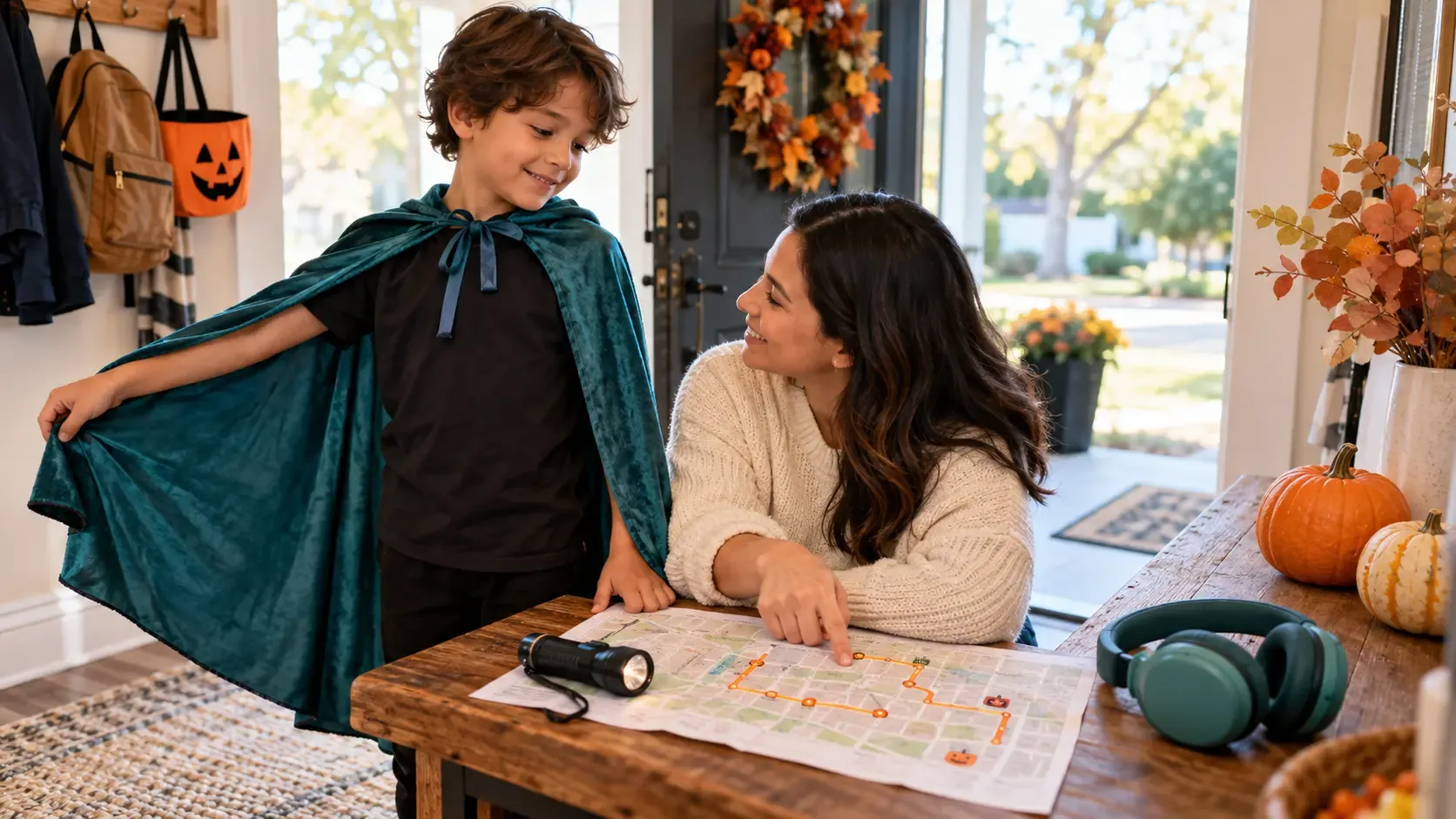
If Halloween makes your child anxious, do not begin by insisting that it is supposed to be fun. Find the hardest part, practice one manageable step, make the plan predictable and agree on how your child can pause or leave.
The goal is not a perfect night or a child who shows no fear. It is a safe experience with enough choice and support for your child to participate at a level they can handle.
A difficult Halloween does not automatically mean your child has an anxiety disorder, autism, ADHD, PTSD or a sensory condition. Age, temperament, frightening decorations, scratchy clothing, noise, social uncertainty, food allergies and a disrupted routine can all matter. Look for patterns beyond one event before drawing conclusions.
First, find the part that is actually hard
Ask at a calm time—not while the costume is half on and other children are waiting.
Try:
“Which part feels hardest: the costume, masks, loud sounds, dark streets, talking at doors, crowds, candy, not knowing what will happen or something else?”
If your child says “I don't know,” offer choices without supplying a diagnosis.
- Fear of masks, skeletons or pretend injuries — What to explore: Does your child understand that the person is wearing a costume? Is one image replaying afterward?; A practical adjustment: Preview mild decorations in daylight; skip graphic displays; let the child watch a familiar person put on and remove a mask.
- Pulling at clothing, covering ears or shutting down — What to explore: Is the costume itchy, hot, tight or hard to see through? Are music, crowds or doorbells too intense?; A practical adjustment: Use soft clothing underneath, remove masks, carry headphones and choose a quieter route or event.
- Refusing to say “trick or treat” — What to explore: Is the difficulty fear of strangers, uncertainty about the script, selective mutism or ordinary shyness?; A practical adjustment: Rehearse at home; let the child point, wave or hold up a card if the household is comfortable with that plan.
- Worry about getting lost or separated — What to explore: Does the child know the route, adult and meeting point?; A practical adjustment: Use a short familiar route, one designated adult and an identification/contact plan.
- Distress about candy or food — What to explore: Is there a food allergy, eating concern, diabetes plan or family rule involved?; A practical adjustment: Follow medical guidance, inspect treats and prepare an alternative reward or swap.
- Fear starts days before and disrupts sleep, school or normal activities — What to explore: Is this part of a broader anxiety pattern?; A practical adjustment: Contact the pediatrician or a child mental-health clinician for assessment.
Young children may have more difficulty separating pretend danger from real danger. The American Academy of Child and Adolescent Psychiatry advises seeking evaluation when anxiety becomes severe or interferes with usual activities such as school, separation or friendships.
Use the PREVIEW plan during the week before Halloween
P — Pinpoint one goal
Choose a goal small enough to observe:
- Wear the costume for ten minutes at home.
- Walk past two decorated houses in daylight.
- Practice knocking and receiving a treat from a relative.
- Attend the first 20 minutes of a school event.
- Hand out candy from home instead of walking the neighborhood.
“Have fun like everyone else” is not a useful goal. “Choose one house to visit, then decide whether to continue” is.
R — Rehearse the sequence
Practice the exact steps:
- Put on the comfortable parts of the costume.
- Carry the bag, flashlight and sensory items.
- Walk to a familiar door.
- Knock or ring once.
- Say “trick or treat,” wave or use the agreed alternative.
- Receive the treat.
- Say thank you, wave or nod.
- Return to the adult.
Keep the rehearsal brief. Stop while it is still manageable rather than turning practice into a test the child must pass.
E — Equip for the actual trigger
Pack only what your child may realistically use:
- Soft clothing or a backup shirt.
- Headphones or ear protection.
- A small flashlight.
- Water and any medically needed supplies.
- A familiar object.
- The written route and meeting plan.
- A safe-food alternative when needed.
A “sensory kit” is not treatment and does not prove a sensory disorder. It is simply preparation for noise, texture, light or crowding.
V — Validate without promising that nothing scary will happen
Try:
“Some decorations may look scary, and we can cross the street or skip that house. You do not have to pretend you are comfortable. We will follow our plan.”
Avoid:
- “There is nothing to be afraid of.”
- “Big kids don't get scared.”
- “We already paid for the costume, so you have to wear it.”
- Repeatedly asking, “Are you okay?” every few seconds.
Validation means recognizing the experience. It does not mean agreeing that every imagined danger is real.
I — Identify an exit signal
Choose a word or hand signal before leaving. Define what happens next:
“If you say ‘porch light,’ we step to the side for two minutes. Then you choose one more house, the quiet route home or going home now.”
Do not make the child earn the right to leave by becoming more distressed. The signal works only if the adult respects it.
E — Ease into participation without building a treatment program
For a mild, specific fear, small and supported practice may be more helpful than a sudden all-or-nothing demand. The American Academy of Pediatrics describes gradual, nonthreatening exposure as one element therapists may use for childhood phobias.
That does not mean parents should design exposure therapy from a blog. Do not surprise a child with a haunted house, remove every coping support or force repeated contact with frightening material. If fear is intense, persistent or connected to trauma, OCD or another condition, ask a qualified clinician to guide the plan.
W — Watch what happens afterward
The next day, ask:
- What was easier than expected?
- What was the hardest moment?
- Which support helped?
- What should we change next time?
Do not conduct a long review at bedtime when everyone is tired. One short conversation is enough.
Make a one-page Halloween plan
Complete this with your child when possible.
My goal
I would like to [write here].
The hardest part may be
[write here].
What helps my body feel more comfortable
[write here].
My script at the door
“Trick or treat.” / wave / point / another agreed option: [write here].
My pause or exit signal
[write here].
When I use the signal, we will
[write here].
Our route and stopping point
Start: [write here]. Maximum: [write here] houses/minutes. Meeting point: [write here].
My backup way to participate
Hand out treats / decorate at home / watch a familiar movie / visit one known neighbor / another option: [write here].
The plan should reduce uncertainty, not become another list your child can fail.
Try the costume before Halloween night
Test the complete costume in ordinary light for ten minutes. Check:
- Can your child see and breathe comfortably?
- Can they walk, sit and use the bathroom?
- Is anything itchy, tight, hot or heavy?
- Can masks or makeup be removed quickly?
- Are shoes safe for the route?
- Is the costume visible to drivers?
- Does makeup cause skin irritation?
- Is a simpler backup outfit ready?
The American Academy of Pediatrics' Halloween safety guidance recommends planning for costume visibility, safe walking and other physical risks. Mental-health preparation does not replace ordinary road, allergy and supervision safety.
During trick-or-treating, keep choices small
Too many questions can add pressure. Offer two workable choices:
“Do you want the quiet street or the three houses near home?”
“Do you want the cape off or the soft shirt underneath?”
“Do you want a two-minute pause or to head home?”
Avoid negotiating in front of a crowd. Step aside, lower your voice and use the plan.
Watch for the child's early signs rather than waiting for a crisis:
- Pulling at clothing.
- Covering ears or eyes.
- Becoming unusually quiet or rigid.
- Repeating the same question.
- Running away from the group.
- Increasing irritability, crying or panic symptoms.
These behaviors can have several explanations. Respond to the immediate need without diagnosing in the street.
Leaving early is not automatically avoidance—or failure
Sometimes going home is the safest and kindest choice. A child may be exhausted, physically uncomfortable, frightened by an unexpected display or unable to recover in a crowded setting.
At other times, automatically canceling every manageable activity can keep a fear from being tested. The right balance depends on the child's age, history, intensity of distress and clinical plan.
Use this question:
“Can my child take one supported, manageable step, or are they too distressed to learn from this moment?”
If you cannot tell, choose safety and discuss the recurring pattern with the pediatrician or mental-health clinician later. Do not turn Halloween night into an unsupervised exposure session.
Offer meaningful alternatives
A child can participate without wearing a costume or visiting many houses. Options include:
- Handing out treats at home.
- Visiting one familiar neighbor in daylight.
- Wearing a favorite shirt instead of a costume.
- Decorating a pumpkin without scary imagery.
- Watching a familiar, age-appropriate movie.
- Doing a home scavenger hunt.
- Attending a quiet or sensory-considerate event.
- Skipping the holiday entirely and doing a normal family activity.
The alternative should not be framed as punishment. Participation is not a measure of bravery, maturity or treatment success.
When to ask for professional help
Consider talking with a pediatrician or child mental-health clinician when fear:
- Persists well after the event.
- Causes repeated nightmares or major sleep disruption.
- Spreads to ordinary clothing, darkness, school, separation or leaving home.
- Leads to panic, aggression, running away or prolonged shutdowns.
- Interferes with school, friendships or family routines.
- Appears connected to trauma, intrusive thoughts or compulsive rituals.
- Comes with depression, self-harm, unsafe behavior or major functional decline.
NIMH guidance on children and mental health recommends considering professional evaluation when emotions or behavior last for weeks, cause distress or interfere with functioning.
Lyte's child-anxiety care guide explains when a pediatrician, therapist or psychiatric clinician may be a useful starting point.
What treatment may involve
When a child has an anxiety disorder, treatment may include cognitive behavioral therapy, parent involvement and carefully planned practice with feared situations. The plan should match the diagnosis, developmental level and family context.
Medication is not automatically needed because a child has one difficult holiday. A prescriber may consider medication for a diagnosed anxiety condition when symptoms are persistent or impairing, after reviewing medical history, other medications, possible benefits, side effects and family preferences. Do not start, stop or borrow medication based on a seasonal article.
Lyte provides child and adolescent care and therapy in Texas. The appropriate starting point depends on the full pattern—not whether a child completed trick-or-treating.
Questions to bring to an appointment
- Is this fear developmentally expected, or does it fit a broader anxiety pattern?
- Could sensory discomfort, trauma, OCD, ADHD, autism, sleep or a medical issue contribute?
- What information should we track across settings?
- Which accommodations support participation, and which may unintentionally maintain fear?
- Would CBT or parent-based treatment be appropriate?
- Should practice with feared situations be guided by a clinician?
- What signs would require urgent help?
- If medication is considered for an underlying condition, what benefits, risks and follow-up should we discuss?
Common Questions
Frequently Asked Questions
Is it normal for a child to be scared of Halloween?
Yes. Masks, pretend injuries, darkness and unfamiliar people can be frightening, especially for younger children. Concern rises when fear is intense, persists beyond the event, spreads to ordinary activities or substantially disrupts sleep, school, friendships or family life.
Should I make my child wear the costume after we bought it?
No. First check whether the costume is itchy, hot, tight, hard to see through or connected to a fear. Offer a simpler version, familiar clothing or no costume. The purchase price should not determine whether a child must remain physically or emotionally uncomfortable.
Does leaving early make anxiety worse?
Not necessarily. Leaving may be appropriate when a child is unsafe, overwhelmed or unable to recover. Repeatedly avoiding every manageable situation can sometimes maintain fear, but Halloween night is not the time to improvise treatment. Use small practice beforehand and seek clinical guidance for persistent anxiety.
What can I say if my child refuses to knock on a door?
Try: “You can watch me first, practice with me or skip this house.” If speaking is the difficult part, agree beforehand on a wave, point or other respectful option. Do not shame the child or disclose a diagnosis to neighbors without permission.
Are headphones or a comfort item reinforcing anxiety?
They may be reasonable supports for noise, crowding or an unfamiliar routine. Whether a support helps participation or becomes limiting depends on the child and treatment goals. For an ongoing anxiety disorder, discuss the balance with the treating clinician rather than abruptly removing supports.
How can I help a child who is frightened by masks or decorations?
Preview mild displays in daylight, explain that a familiar person is wearing a costume, let the child watch a mask go on and off, and skip graphic displays. Keep the practice optional and brief. Persistent fear that affects ordinary life deserves evaluation.
Can medication help Halloween anxiety?
Medication is not a routine solution for one event. It may be part of treatment for a diagnosed anxiety condition when a qualified prescriber determines the potential benefits outweigh the risks. Never give a child someone else's medication or change a prescription for Halloween without the treating clinician.
When should I call a professional?
Call when fear lasts for weeks, causes major sleep or school disruption, spreads to other settings, or involves panic, trauma symptoms, compulsions, aggression, running away, self-harm or a marked decline in functioning. Start with the pediatrician or a qualified child mental-health clinician. Use emergency services for immediate danger.
Insurance & Cost Questions?
Lyte Psychiatry accepts BCBS, UnitedHealthcare, Cigna, Aetna, Humana, and more. Most patients pay $0–$30 per visit.
Further Reading
NIMH — Anxiety Disorders
Diagnostic criteria and treatment options
ADAA — Anxiety Statistics
40M Americans affected — prevalence and impact data
APA — Anxiety Overview
Clinical summary from the American Psychological Association
These topic resources supplement the references linked within the article.
Related Care and Resources
Specialized Care
Lyte Psychiatry — Texas
Anxiety Treatment — Texas
Evidence-based care for generalized anxiety, social anxiety, panic disorder, and phobias.
Find Care Near You
Lyte Psychiatry serves patients across Texas — in-person in DFW and via telehealth statewide.
Don't see your city? View all Texas locations →
Questions about cost? View insurance and payment information