Mon Nov 16 2026
Grief During the Holidays: When It Doesn't Ease
A first-holiday plan, rituals, family scripts and a self-check for when grief during the holidays doesn't ease, plus red flags and Texas support options.
Published by Lyte Psychiatry · Meet our care team
Written by the Lyte Psychiatry clinical team. Clinically reviewed by Ana G., LPC, and medically reviewed by Dr. Akinwande Akintola, MD, supervising physician. Last reviewed: November 16, 2026.
Grief during the holidays is often heavier than grief on an ordinary day, because the season is built around the people we have lost. That is a normal response, not a sign that something is wrong with you. The National Institute on Aging says the feelings that come with grief are normal, and a plan made ahead of time can make the hardest days more manageable.
This guide is for anyone facing a first holiday season after a death, and for people whose grief has not loosened its grip even after a year or more. It is also for the family members around them who want to help and do not know what to say. You will find a first-holiday plan, remembrance ideas, word-for-word scripts, a self-check that separates normal grief from prolonged grief and depression, and clear signs that it is time to get help.
Key takeaways
- Holidays sharpen grief because they are full of routines, places and rituals that included the person who died. Feeling worse in November and December is common and expected.
- You do not have to choose between canceling the holidays and pretending to be fine. A short written plan, with an exit route and one act of remembrance, gives you a middle path.
- Most grief eases with time, even though it never fully disappears. The American Psychiatric Association describes prolonged grief disorder as grief that stays intense and keeps getting in the way of daily life long after the loss.
- Grief and depression can overlap. Thoughts of suicide, heavy drinking, or being unable to function for weeks are reasons to get help now, not after the holidays.
- In Texas, every county has a local mental health authority with a crisis line, and the 988 Lifeline offers text and chat in Spanish.
Why is grief during the holidays so hard?
The holidays are hard because nearly every tradition carries a memory of the person who died, and the culture around you insists on cheer. Empty chairs, old recipes and familiar songs act as reminders all at once, in a short span of weeks, often while you are tired and short on daylight.
Think about how the season actually unfolds. In early November the clocks fall back, and suddenly it is dark when you leave work. That extra evening at home can feel very long when the person who used to fill it is gone. Then come the store displays, the group texts about who is bringing what to Thanksgiving, the office party invitation, the holiday cards with one name missing.
There is also the gap between how you feel and how you are expected to feel. Every "happy holidays" asks you to perform a mood you do not have, and that takes energy you may not have to spare.
Finally, the holidays put families in the same room. That can be a comfort, but it also brings up old tension, different grieving styles and hard questions, like who sits where, who carves the turkey, or whether to hang the stocking. When everyone is hurting in a different way, small decisions can turn into big arguments.
What does normal grief look like, and how long does it last?
Normal grief can include sadness, crying, numbness, anger, trouble sleeping and a hard time concentrating, and it tends to come in waves rather than a straight line. MedlinePlus says the most intense phase may last up to about two months, while milder symptoms can continue for a year or longer.
According to MedlinePlus, common reactions include denial or numbness, anger, bargaining, sadness and eventually acceptance, though not everyone feels all of them and they do not arrive in a neat order. A sudden or violent death can take longer to accept than an expected one. The NIA adds that grief can bring both physical and emotional pain, so a tight chest, an upset stomach or deep fatigue can be part of it too.
What matters most is direction over time. In typical grief, the bad days slowly become less frequent, even if a song in a grocery store can still knock the wind out of you years later. You start to be able to hold good memories without only feeling the loss. That does not mean you have "moved on." It means the grief is changing shape, which is what grief usually does.
What is the first Christmas after a death like?
The first Christmas, Hanukkah, Thanksgiving or other major holiday after a death is often the hardest one, because every tradition is happening for the first time without that person. Many people find the days leading up to it worse than the day itself, since dread builds while you wait.
The firsts tend to stack up. The first Thanksgiving without Mom's dressing. The first time no one calls on Christmas morning at 7 a.m. because Dad always called first. Others feel fine for weeks and then fall apart over something small, like a recipe card in their own handwriting.
All of these patterns are common. You cannot predict exactly how the day will go, so the goal is not to control the feeling. The goal is to decide in advance what you will do, who you will be with, and how you will take care of yourself if the feeling gets too big. That is what the plan below is for.
How do you cope with grief during the holidays? A first-holiday plan
You cope by planning ahead, scaling the season down to what you can handle, building in one deliberate moment of remembrance, and protecting basic sleep, food and movement. Write the plan down a week or two early, share it with one trusted person, and give yourself permission to change it on the day.
- Pick your anchor days. Look at the calendar from Thanksgiving through New Year's Day and circle the dates most likely to hurt: the holiday itself, a birthday, the date of the death, a party you usually went to together. You will plan for these specifically instead of dreading the whole season.
- Decide what stays, what changes and what pauses. For each tradition, ask whether keeping it would comfort you or crush you this year. You might keep the tree but skip the big dinner. You might have dinner at a sibling's house instead of the family home. A pause is not a permanent decision.
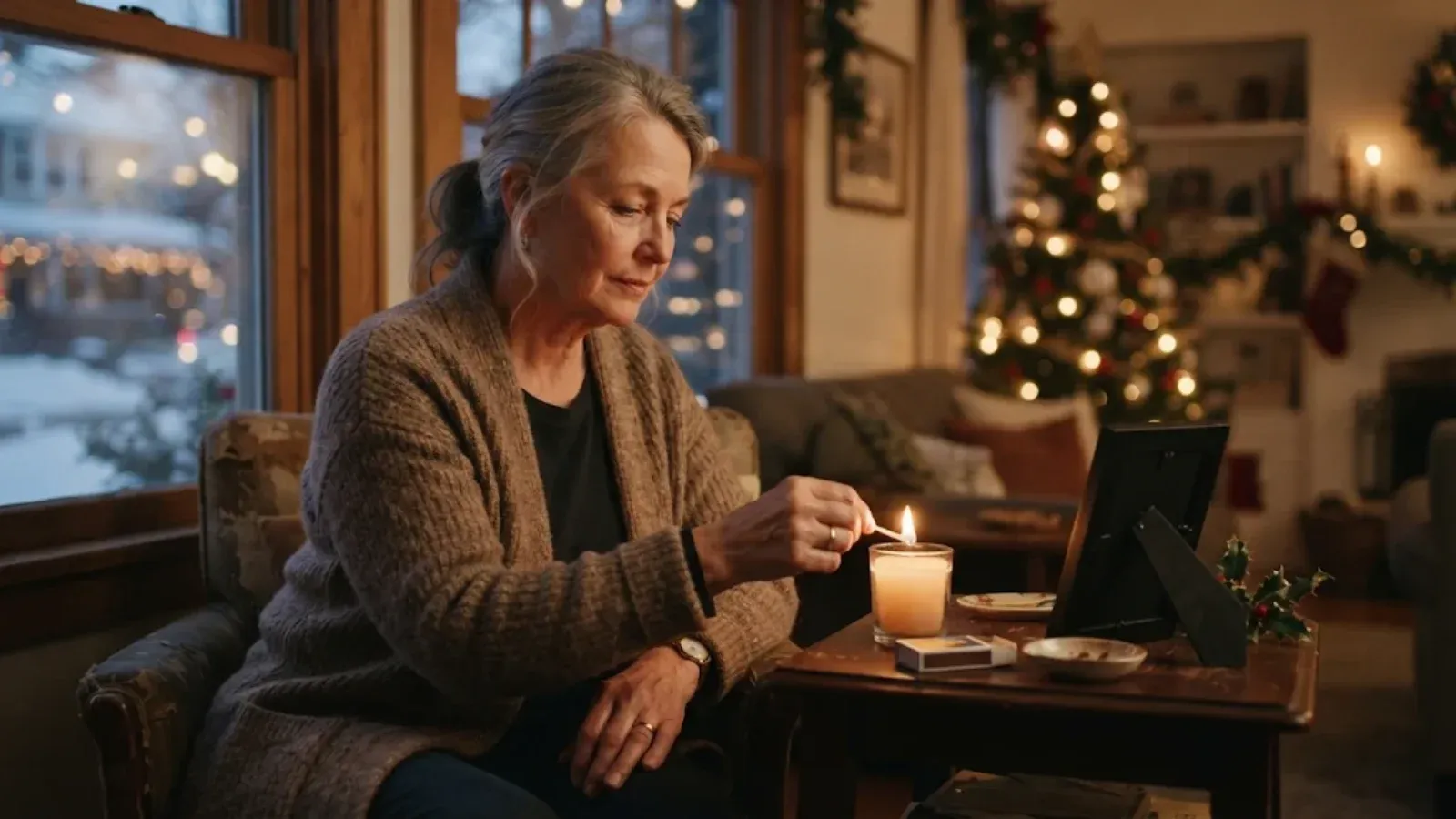
- Choose one act of remembrance. Pick something small and specific, like lighting a candle before the meal or making their signature dish. Having one planned moment often makes the rest of the day easier, because the grief has a place to go.
- Plan your exit. Drive yourself so you can leave. Agree on a signal with one person who will cover for you. Decide in advance that leaving after dessert, or after an hour, counts as showing up.
- Protect the basics. The NIA advises people who are grieving to exercise regularly, eat healthy food and try to get enough sleep. During the holidays, that might mean a walk before the gathering, a real breakfast and a set bedtime even on days off.
- Watch the alcohol. Drinking more to get through gatherings is common and it tends to backfire, making sleep and mood worse. MedlinePlus lists rising alcohol or drug use as a reason to contact a health care provider.
- Delay big decisions. An NIH emotional wellness checklist suggests waiting a while before major changes like moving or changing jobs.
- Schedule the day after. Plan something gentle for the morning after each anchor day, like coffee with a friend or a slow walk. Grief often hits hardest once the adrenaline wears off.
Rituals and remembrance ideas
Remembrance rituals give grief a planned place to land, so it does not leak into every moment of the day. The right ritual is one that fits your family, your faith or lack of one, and the person you are missing. Here are ideas that work for different people.
Quiet rituals for one
- Write a letter to the person about the year since they died, then keep it, burn it safely or read it at their grave.
- Wear something of theirs, like a watch, a scarf or a ring, on the holiday itself.
Rituals for the table
- Light a candle at the start of the meal and say their name out loud.
- Make their signature dish, even if it does not turn out quite right. Tell the story of the year it went wrong.
- Put a small jar and slips of paper by the door. Ask guests to write one memory, then read a few aloud after dessert.
Rituals that look outward
- Donate to a cause they cared about, or volunteer with a group they supported.
- Buy the gift you would have given them and donate it to a toy drive or shelter.
- Plant a tree or a perennial in late fall, when planting weather is mild in much of Texas.
It is fine if a ritual feels awkward the first year. It is also fine to skip a ritual you planned if, on the day, you simply cannot.
What to say to family: scripts that help
Clear, simple words protect your energy and prevent hurt feelings. You do not owe anyone a long explanation. These scripts are starting points, so change the words until they sound like you.
When you need to change a tradition
- "I can't host this year. I'd love to come to yours for a couple of hours, and I may leave early."
- "Let's keep the tree but skip the big dinner this year. I'm not up for a crowd."
When you want them to talk about the person
- "Please say Dad's name. It helps me more than it hurts."
- "I'd love it if everyone shared one story about her at dinner."
When you need people to stop
- "I know you mean well. I'm not ready to talk about selling the house. Can we pick another topic?"
- "I'm going to step outside for a few minutes. I'm okay, I just need air."
When someone asks how you are
- "Honestly, the holidays are rough this year. Thanks for asking."
- "Some days are better than others. Today is a middle one."
For family members supporting someone
- "I've been thinking about your mom a lot. What's one thing I could do this week that would help?"
- "Do you want to talk about him, or would you rather we just watch the game together?"
- "I'm going to the store Thursday. Text me a list and I'll drop it off."
Try to avoid lines that rush the grief, like "they're in a better place" or "at least they're not suffering anymore," unless the grieving person says it first. Specific offers of help usually land better than "let me know if you need anything."
A hypothetical example: the first Thanksgiving
This is a hypothetical example, not a real patient. A woman in her 40s in Arlington lost her father in the spring. He always fried the turkey in the driveway, and the family gathered at his house. As November begins and the evenings turn dark early, she notices she is sleeping badly and snapping at her kids. Her siblings keep texting about plans, and she has not answered.
She sits down on a Sunday with a notepad. She circles three anchor days: Thanksgiving, her father's birthday in early December and Christmas Eve. She decides Thanksgiving will move to her sister's house, with a smaller oven-roasted turkey, because she cannot face the driveway fryer yet. She volunteers to bring his pecan pie and asks her brother to tell the story of the year the fryer caught fire. She texts her sister: "I'm in, but I'm driving myself and may leave after dessert."
On the day, she cries in the car before going in. The meal is hard and also, in places, warm. She leaves early, as planned, and goes for a walk the next morning with a friend. By mid-December she is still sad, but she is sleeping better and can talk about her father without shutting down. In this example, her grief is painful and normal. If, by the next fall, she still could not function at work, avoided anything that reminded her of him and felt life had no meaning, that would be a different picture, and a reason to see a clinician.
When grief doesn't get better: what does that mean?
When grief stays just as intense months after a loss, keeps you from working or caring for yourself, or seems to get worse rather than slowly change, it may be more than typical grief. It could be prolonged grief disorder, depression or both, and a clinician can help sort out which.
Signs that grief may be stuck include feeling that the death still is not real long after it happened, avoiding anything that reminds you of the person to the point that your life shrinks, feeling that part of you died with them, or being unable to imagine any future at all.
The NIA notes that complicated grief can be a serious condition and that help is available if sadness is making it hard to carry on with daily life. The holidays often make this easier to see. If the second or third holiday season hits just as hard as the first, with no change at all, that is worth noticing.
What is prolonged grief disorder?
Prolonged grief disorder is a diagnosis for intense, persistent grief that lasts well beyond what is typical and causes real problems in daily life. The American Psychiatric Association says that for adults, at least 12 months must have passed since the death, and for children and adolescents, at least 6 months.
According to the American Psychiatric Association's page on prolonged grief disorder, the person must have at least 3 of 8 symptoms nearly every day for at least the past month. Those symptoms are:
- Feeling as though part of yourself has died
- Marked disbelief about the death
- Avoiding reminders that the person is dead
- Intense emotional pain, such as anger, bitterness or sorrow
- Trouble reengaging with friends, interests or plans for the future
- Emotional numbness
- Feeling that life is meaningless
- Intense loneliness or feeling detached from others
The grief must also last longer than social, cultural or religious norms would expect. How common it is depends on the study and the kind of loss. In a 2022 study in Frontiers in Psychiatry, 4.7% of bereaved participants were identified as likely cases, and that paper notes rates run higher after sudden or violent deaths. Only a clinician can make this diagnosis. The list is here to help you decide whether to ask, not to diagnose yourself or someone else. For a fuller look at the timeline, see our guide to prolonged grief disorder signs.
Can grief turn into depression?
Yes, grief can lead to depression, and the two can exist together. MedlinePlus notes that ongoing grief can turn into depression and that persistent symptoms may point to clinical depression. Depression tends to color everything, while grief tends to center on the person who died.
The NIMH says a diagnosis of depression requires symptoms most of the day, nearly every day, for at least 2 weeks. Those symptoms include a persistent sad, anxious or empty mood, hopelessness, changes in sleep and appetite, trouble concentrating and thoughts of death or suicide. In grief, the sadness usually comes in waves tied to reminders, and a person can still feel pleasure in other parts of life. In depression, the low mood is more constant and may come with a sense of worthlessness that has little to do with the loss itself.
Losing interest in things you once enjoyed is part of both. If everything feels flat, not just the holidays, our post on anhedonia and why nothing feels fun explains that symptom in more depth.
Self-check: normal grief, prolonged grief or depression?
This comparison is a starting point for a conversation with a clinician, not a diagnosis. The three often overlap, and a person can have more than one at once.
- Normal grief: Pain comes in waves, often triggered by reminders. Intensity slowly eases over months, though holidays and anniversaries bring spikes. You can still feel moments of warmth, humor or connection. Thoughts focus on the person and the loss.
- Prolonged grief disorder: At least 12 months after the death for adults, longing or preoccupation with the person stays intense nearly every day. Disbelief, avoidance, numbness or a sense that life is meaningless keep you from rejoining work, friends or plans, according to the APA criteria.
- Depression: Low mood, emptiness or loss of interest is present most of the day, nearly every day, for at least 2 weeks, per NIMH. It spreads beyond the loss into how you see yourself, often with worthlessness, hopelessness and changes in sleep, appetite and energy.
Now ask yourself these questions, and answer honestly:
- Is the pain slowly changing over time, even if the holidays bring a spike?
- Can I still feel some pleasure, warmth or humor, even briefly?
- Am I able to work, cook, shower and pay bills most days?
- Has it been more than a year, and does the grief feel just as raw as at the start?
- Am I avoiding places, people or objects so much that my life has narrowed?
- Do I feel worthless or like a burden, beyond missing the person?
- Have I had thoughts of death or of not wanting to be alive?
Mostly yes to the first three and no to the rest points toward typical grief, painful as it is. Yes to questions 4 through 6 is a good reason to book an evaluation. Yes to question 7 means reach out today, using the steps in the next section.
Red flags: when to get help sooner
Some signs mean you should not wait until after the holidays. Get help now if any of these apply to you or someone you love.
- Thoughts of suicide or of joining the person who died. Call or text 988 now. Call 911 if there is immediate danger.
- Drinking or using drugs more to cope. MedlinePlus lists increased alcohol or drug use as a reason to contact a provider.
- Not functioning. Missing work for days, not eating, not getting out of bed or not caring for children or pets.
- Depression that is severe or long-lasting. MedlinePlus says depression that interferes with daily life is a reason to call a provider.
- Grief that feels unmanageable. Panic, sleeplessness night after night, or feeling unable to cope at all.
- Giving away belongings or saying goodbye in a way that feels final.
The NIH checklist puts it simply: talk to your doctor if you're having trouble with everyday activities. You do not need to be in crisis to deserve help.
What helps when grief stays heavy?
Several kinds of support can help when grief stays heavy, including grief counseling, support groups and specific therapies for prolonged grief. When depression is also present, treatment often involves psychotherapy, medication or both. A clinician can help you choose based on what you are actually experiencing.
The APA page on prolonged grief disorder describes therapy approaches based on cognitive behavioral therapy, including prolonged grief therapy, which focuses on accepting the loss and rebuilding a meaningful life. The same page mentions bereavement support groups and cognitive behavioral therapy for insomnia, and notes that no medications are currently approved specifically for grief symptoms. If sleep is the piece that is falling apart, our guide to CBT-I for insomnia walks through how it works.
For depression, the NIMH says treatment typically involves psychotherapy, medication or both. Whether medication makes sense for you is a decision to make with a prescriber, not something to decide from an article. The NIH checklist also notes that sometimes short-term talk therapy can help, and that a grief support group is another option.
Help can also look less formal, like a weekly call with a friend or an evening walk. These are not a replacement for care when you need it, but they are real support. If you also care for an aging parent who is grieving, our post on caregiver stress before the holidays may help you plan for both of you.
Anniversaries after the holidays
The holiday season is rarely the only hard stretch. The date of the death, the person's birthday and a wedding anniversary can each bring a fresh wave, sometimes months after the holidays end.
The same approach applies: mark the date ahead of time, plan one act of remembrance and arrange company or a gentle task for the day after. Our grief anniversary plan lays this out step by step. It is also worth knowing that short days and long nights can lower mood on their own. If the winter months feel heavy in a way that goes beyond the loss, read about seasonal depression in Texas.
Grief during the holidays in Texas
Texas brings its own twists. Families are often spread across a big state, so the first holiday may mean a long drive on I-35 or I-20 to a house that feels different now. Our December weather is often mild, so the season does not always "look" like the holidays, which can make the dissonance between the calendar and your mood even stronger. Many families also mark the season with traditions that are both religious and cultural, from Las Posadas to large church gatherings, and stepping back from them can feel like stepping back from community.
A few Texas-specific resources are worth knowing before you need them:
- Local crisis lines. Texas Health and Human Services says that in a mental health crisis you can call the crisis hotline of the local mental health or local behavioral health authority for your county. In Tarrant County, MHMR of Tarrant County lists its crisis line as 800-866-2465 (call or text). In Dallas County, the North Texas Behavioral Health Authority lists its 24/7 crisis line as 866-260-8000. Numbers can change, so check the agency site.
- 988 in Spanish. The 988 Lifeline says its text and chat services are available in Spanish, which can matter for families where an older relative is most comfortable in Spanish.
- 2-1-1 Texas. The same Texas HHS page lists 2-1-1 Texas, which you can call or text, alongside 988.
If this is also your first holidays after a mental health diagnosis, our guide on what to share with family may help.
Getting support in Texas
If grief during the holidays is starting to look like more than grief, or if you are not sure, an evaluation can help you understand what is going on. Lyte Psychiatry offers therapy, psychiatric evaluation and medication management in Texas. In-person visits are available at Lyte Psychiatry's clinic in Pantego, in the Dallas–Fort Worth area. Lyte Psychiatry offers telehealth visits to patients who are physically located in Texas at the time of the visit, which can help when you do not have the energy to drive across town in December.
Most new patients are seen within 1–2 business days. Weekend appointments are limited. All Lyte Psychiatry services are available in Spanish. Availability, insurance and clinician fit require confirmation. Lyte Psychiatry is an outpatient practice. It does not provide inpatient care, crisis or after-hours coverage, medically supervised detox, or intensive outpatient or partial hospitalization programs.
You can learn more about therapy at Lyte Psychiatry, depression care or telepsychiatry in Texas. Whether you reach out this week or after the new year, you do not have to carry this season alone.
If you are in a mental-health crisis in the United States, call or text 988. Call 911 for immediate danger.
Educational information, not a diagnosis or individual treatment plan.
Common Questions
Frequently Asked Questions
Is it normal to not want to celebrate the holidays after a death?
Yes, it is very common to want to skip the holidays after a death, especially the first year. Wanting to pull back is a normal part of grief, not a sign you are failing. You can scale traditions down, change where they happen or pause them for a year, and still spend some time with people who care about you.
How do I get through the first Christmas after a death?
Plan it ahead instead of waiting to see how you feel. Choose which traditions to keep, change or pause, pick one act of remembrance, such as lighting a candle, and drive yourself so you can leave early. Tell one trusted person your plan, and schedule something gentle for the next morning, when grief often hits hardest.
How long does normal grief last?
There is no set timeline, but MedlinePlus says the most intense phase of grief may last up to about two months, with milder symptoms continuing for a year or longer. Grief usually comes in waves that slowly become less frequent. Holidays, birthdays and the anniversary of the death can bring strong spikes even years later, and that is common.
What is prolonged grief disorder?
Prolonged grief disorder is a diagnosis for grief that stays intense and disrupts daily life long after a loss. The American Psychiatric Association says it requires at least 12 months since the death for adults, or 6 months for children, plus at least 3 of 8 listed symptoms nearly every day for the past month. Only a clinician can diagnose it.
How is grief different from depression?
Grief usually centers on the person who died and comes in waves tied to reminders, with moments of warmth still possible. Depression, which NIMH says involves symptoms most of the day, nearly every day, for at least two weeks, tends to color everything, including how you see yourself. The two can overlap, so a clinician's evaluation helps sort them out.
When should I get help for grief that doesn't get better?
Get help if grief feels just as raw after many months, keeps you from working or caring for yourself, or makes your life shrink around avoiding reminders. Get help right away for thoughts of suicide, heavier drinking or drug use, or being unable to function. In the United States, call or text 988, and call 911 for immediate danger.
Is there a medication for grief?
The American Psychiatric Association says no medications are currently approved specifically for grief symptoms. Therapy approaches, including prolonged grief therapy and cognitive behavioral therapy for insomnia, along with support groups, are the main options it describes. If depression is also present, treatment may involve psychotherapy, medication or both, and that is a decision to make with a prescriber.
What can I say to a family member who is grieving during the holidays?
Say the person's name and make a specific offer. Try something like, "I've been thinking about your mom. What's one thing I could do this week that would help?" or "I'm going to the store Thursday, text me a list." Avoid rushing the grief with lines like "they're in a better place" unless the grieving person says it first.
Can I get grief support by telehealth in Texas?
Yes, telehealth is an option for many people in Texas who are grieving. Lyte Psychiatry offers telehealth visits to patients who are physically located in Texas at the time of the visit, and all services are available in Spanish. In-person visits are available at the clinic in Pantego, in the Dallas–Fort Worth area. Availability and clinician fit require confirmation.
Further Reading
NIMH — Depression Overview
Prevalence, symptoms, and evidence-based treatments
CDC — Mental Health Data & Statistics
National survey data on depressive disorders
APA — Depression Fact Sheet
Clinical guidance from the American Psychological Association
These topic resources supplement the references linked within the article.
Your next steps for depression care
Choose the question that fits where you are now. Self-help tools support reflection and preparation; they do not diagnose a condition or replace care.
Who could I meet?
- Dr. Akinwande Akintola, MDSupervisory Psychiatrist & Medical Director
- Prishina Jimenez, LPCLicensed Professional Counselor
The clinic confirms clinician fit, availability and insurance participation before scheduling.
Meet all Lyte clinicians · Understand provider roles
What will it cost, and how do I book?
Check insurance and benefits · View self-pay prices
Request an appointmentLyte Psychiatry — Texas
Depression Treatment in Texas
Medication management and therapy for major depression, persistent depressive disorder, and seasonal depression.
Find Care Near You
Lyte Psychiatry serves patients across Texas — in-person in DFW and via telehealth statewide.
Don't see your city? View all Texas locations →
Questions about cost? View insurance and payment information