Wed Sep 30 2026
Teen Sleep Deprivation: A 7-Night Family Plan
Help an exhausted teenager build a realistic school-night plan. Set a wake-time anchor, make a phone agreement and know when sleep needs medical care.
Published by Lyte Psychiatry · Meet our care team
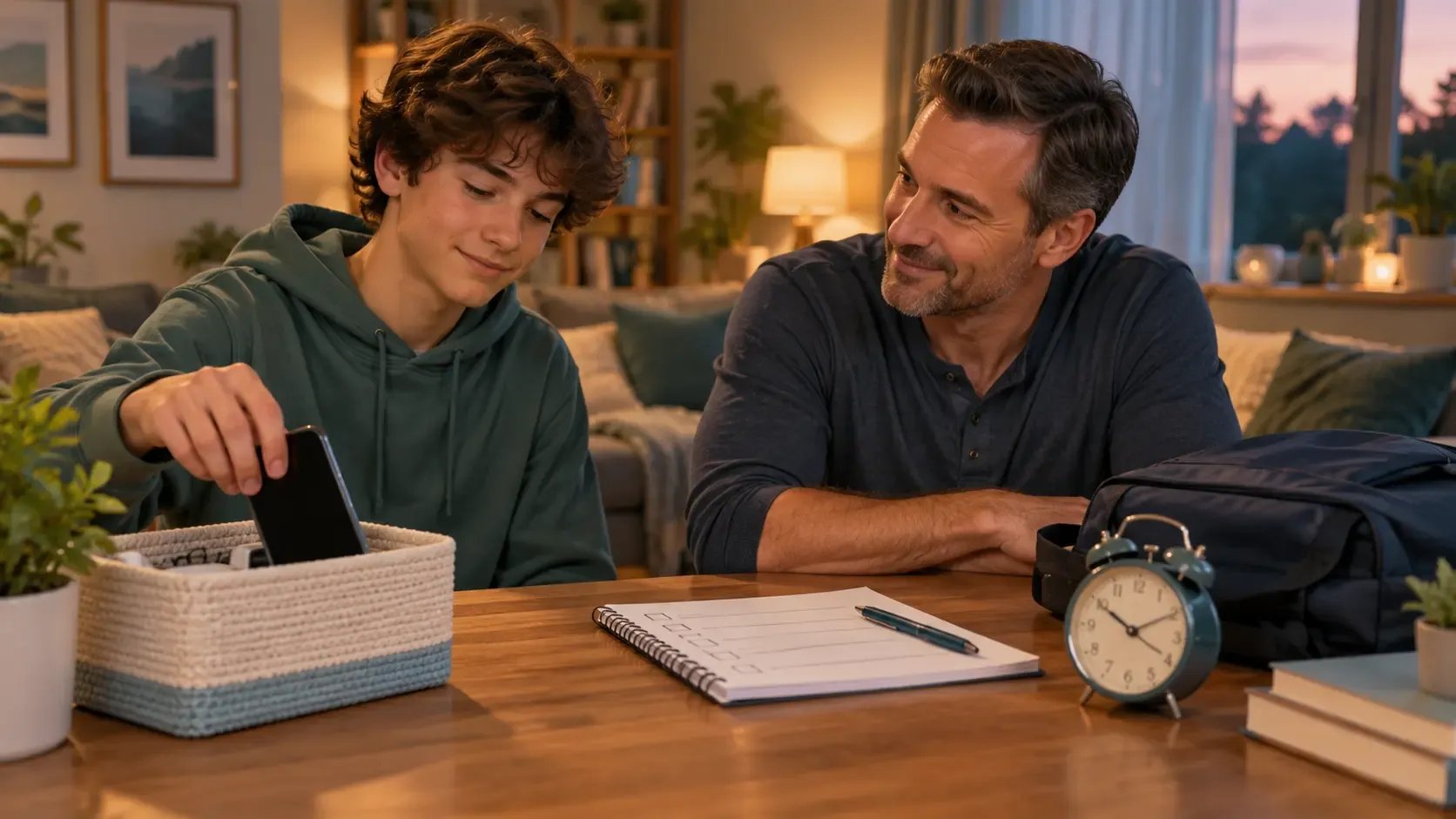
Most teenagers ages 13–18 need 8–10 hours of sleep each night. If your teen is routinely exhausted, start with a shared seven-night plan: anchor the school-day wake time, work backward to protect enough sleep opportunity, move nighttime phone use out of reach and track what actually gets in the way.
The goal is not to force sleep on command. It is to create a realistic opportunity for sleep, identify barriers and know when the problem needs medical or mental-health care.
First, check what “tired” means
Ask your teen what is happening without beginning with blame:
“I notice mornings have been rough and you seem exhausted after school. I don't want this to become another argument about your phone. Can we look at the whole schedule and try one plan for a week?”
Look for details:
- Is there too little time available for sleep?
- Does your teen lie awake even with enough time?
- Do they snore loudly, gasp, stop breathing or wake with headaches?
- Are restless sensations, pain, medication effects, caffeine or substances involved?
- Are anxiety, depression, trauma, elevated mood or racing thoughts affecting sleep?
- Are they falling asleep in class, while riding in a car or behind the wheel?
The answers point to different next steps. A schedule problem is not the same as insomnia, sleep apnea or a mood disorder.
Safety comes before the seven-night experiment
A sleepy teen should not drive. NHTSA identifies young drivers and people who sleep very little as higher-risk groups for drowsy-driving crashes. Arrange another ride rather than relying on loud music, open windows or caffeine to make unsafe driving safe. NHTSA: Teen Driving.
Seek prompt medical advice for loud habitual snoring, gasping, breathing pauses, unusual nighttime behaviors, sudden extreme sleepiness or symptoms suggesting another health problem. HealthyChildren recommends discussing snoring and possible sleep apnea with a doctor. HealthyChildren: Sleep and Mental Health.
If your teen expresses hopelessness, self-harm thoughts or feeling unsafe, take it seriously. Call or text 988 in the United States for crisis support, and call 911 for an immediate life-threatening emergency.
Build the plan with your teen, not around them
1. Anchor the required wake time
Write down the actual time your teen must wake for school, transportation and morning needs. Do not start with an ideal bedtime.
2. Work backward for sleep opportunity
CDC cites an 8–10-hour recommendation for ages 13–18. Use the wake time to identify a range that protects enough time in bed, then include a realistic wind-down period. CDC: Sleep and Health.
This is planning time, not a guarantee of sleep. A teen who cannot fall asleep despite sufficient opportunity may need a different assessment.
3. Find the real collision
Place the evening on one line:
- Homework — What to examine together: Is the workload predictable? Is starting late the main problem?
- Sports/work — What to examine together: Can transportation, shifts or activity timing change?
- Family duties — What to examine together: Are responsibilities shared fairly and scheduled clearly?
- Social connection — What to examine together: Is the phone the only time friends are available?
- Anxiety — What to examine together: Does worry rise when lights go out?
- Afternoon naps — What to examine together: Are long or late naps making nighttime sleep harder?
Do not assume every late bedtime is defiance. Adolescents naturally tend toward later sleep and wake timing, while early school schedules compress the available window. NHLBI: What Makes You Sleep?.
4. Make one phone agreement
CDC recommends setting boundaries on nighttime digital media and storing phones outside the bedroom. Choose a rule the family can actually follow for seven nights, such as a shared charging location one hour before the planned bedtime. Adults should follow the family rule where practical rather than making the teen the only person disconnected. CDC: Youth Sleep.
Ask what the phone is doing for your teen. If it is an alarm, use an alarm clock. If it is contact with a distressed friend, plan another boundary and identify an adult who can help. If homework requires a device, separate school use from scrolling rather than pretending they are identical.
Try this script:
“For seven nights, let's charge phones in the kitchen at [write here]. If schoolwork truly runs late, tell me before that time so we can adjust the plan instead of arguing at midnight.”
5. Create a short wind-down sequence
Choose two or three steps that reduce decisions: prepare the backpack, complete hygiene, dim optional lights and do one familiar quiet activity. Keep it simple enough for busy nights.
Avoid adding supplements or someone else's sleep medicine. If melatonin or another product is being considered, ask your teen's pediatric or prescribing clinician about whether it is appropriate, product quality, interactions and timing. An article cannot provide an individualized dose.
Use this seven-night tracker
The tracker measures the pattern; it does not grade your teen.
- Phone parked — Example—not a patient story: “10:00 p.m.”
- Lights-out attempt — Example—not a patient story: “10:35 p.m.”
- Estimated time to fall asleep — Example—not a patient story: “About 40 minutes”
- Night waking — Example—not a patient story: “Once; returned to sleep”
- Wake time — Example—not a patient story: “6:30 a.m.”
- Morning/daytime effect — Example—not a patient story: “Hard to wake; slept in last class”
- Barrier — Example—not a patient story: “Homework started after practice”
- One change tonight — Example—not a patient story: “Begin math before dinner”
Do not ask a teen to watch the clock all night. Estimates are sufficient. At the end of the week, review the log once and ask what made sleep easier or harder.
Lyte's tools and checklists can help organize history and appointment questions.
Have a plan for a bad night
One difficult night does not require abandoning the whole plan.
The next morning:
- Protect driving safety and arrange transportation if your teen is too sleepy to drive.
- Keep the wake time reasonably close to the plan unless a clinician has advised otherwise.
- Avoid turning the morning into a lecture.
- Identify the one barrier that can change that evening.
- Contact a clinician when severe sleepiness, breathing concerns or persistent insomnia is present.
Large weekend shifts may make Monday harder. CDC recommends regular bed and wake times, including weekends, while recognizing that schedules sometimes require adjustment. The family goal is consistency, not perfection. CDC sleep guidance.
When sleep needs an evaluation
Arrange a pediatric or primary-care visit when the problem persists despite enough sleep opportunity, causes major daytime impairment or includes snoring, breathing pauses, unusual movements or extreme sleepiness. NHLBI notes that sleep studies and other testing may be used when clinicians suspect sleep apnea, movement disorders, narcolepsy or other conditions. NHLBI: Sleep Deficiency Diagnosis.
Mental-health assessment may be useful when worry, panic, low mood, trauma symptoms, attention difficulties, substance use or periods of unusually high energy and little need for sleep are part of the pattern. Not needing sleep while feeling energized is different from wanting sleep but being unable to get it.
Lyte offers child and adolescent mental-health care in Texas. Care should still include the teen's pediatric or sleep clinician when a medical sleep disorder is possible.
What treatment may involve
Treatment should match the cause. It may include schedule changes, treatment of a medical or sleep condition, cognitive behavioral therapy for insomnia, or care for anxiety, depression, ADHD or another diagnosed condition. HealthyChildren describes CBT as a possible way to address stress, anxiety and the sleep-wake cycle. HealthyChildren: Teen Trouble Falling Asleep.
Medication is not automatically the first or right answer for a tired teen. A prescriber should review diagnosis, other medications, substances, benefits, adverse effects and monitoring. Do not start, stop or share sleep medication based on an article.
Learn about therapy at Lyte and ask whether the available clinician has experience with adolescent sleep and the condition being considered.
Bring this summary to the appointment
“For the last [write here] weeks, bedtime is around [write here] and wake time is [write here]. The main problem is falling asleep/staying asleep/waking up/extreme daytime sleepiness. We tried [write here] for seven nights. The log shows [write here]. We have/have not noticed snoring, breathing pauses, restless sensations, mood changes, medication changes or substance use. We need help deciding what should be evaluated next.”
Questions to ask:
- Does this look like insufficient opportunity, insomnia, a circadian timing problem or another sleep disorder?
- Do snoring or breathing symptoms require a sleep evaluation?
- Could a medication, caffeine, energy drink or substance be contributing?
- How should anxiety, depression or ADHD be assessed alongside sleep?
- What should the school know, if anything?
- Is CBT-I appropriate and available for this age?
- If a medication or supplement is considered, what are the risks and follow-up plan?
Lyte Psychiatry provides in-person psychiatric care in Pantego and psychiatry and therapy by telehealth across Texas. Families can ask whether Lyte's child/adolescent services fit the concern and what outside medical or sleep evaluation may also be needed.
Related guides from Lyte
Common Questions
Frequently Asked Questions
How much sleep does a teenager need?
Most adolescents ages 13–18 need 8–10 hours per 24 hours on a regular basis. Individual needs vary, but a teen who is persistently exhausted or impaired deserves more than a simple “go to bed earlier” instruction.
Why does my teenager stay up so late?
Adolescent body-clock timing naturally shifts later, and homework, work, activities, stress, caffeine and devices may push bedtime further. Understanding the actual barrier is more useful than assuming laziness or defiance.
Should I take my teen's phone away at night?
A collaborative charging agreement is often more sustainable than a surprise confiscation. CDC recommends nighttime digital-media boundaries and storing phones outside the bedroom. Address homework and social-safety needs directly.
Is sleeping until noon on weekends harmful?
Sleeping later may reflect accumulated sleep loss, but a very large schedule shift can make the next school night harder. Aim for a workable, reasonably consistent schedule and discuss persistent exhaustion with a clinician.
Can my teenager catch up on sleep with naps?
Naps may reduce immediate sleepiness but can also make nighttime sleep harder when long or late. Track timing and ask a clinician for individualized guidance if naps are frequent or necessary to function.
Is melatonin safe for teenagers?
Do not assume an over-the-counter product is automatically appropriate. Ask the pediatric or prescribing clinician about the actual sleep problem, product quality, interactions, timing and monitoring rather than choosing a dose from the internet.
When should snoring be checked?
Loud habitual snoring, gasping, breathing pauses, morning headaches or significant daytime sleepiness warrant medical discussion. These symptoms may require evaluation for sleep-disordered breathing or another condition.
Can anxiety or depression cause teen sleep problems?
Yes, both can affect sleep, and poor sleep can worsen daily functioning and mood. Sleep changes alone do not establish a diagnosis. Seek an assessment when mood, worry, functioning or safety is affected.
Further Reading
CDC — Sleep & Mental Health
1 in 3 adults don't get enough sleep — CDC data
Sleep Foundation — Insomnia & Psychiatry
The link between sleep disorders and mental health conditions
NIMH — Sleep Disorders
Co-occurring sleep and psychiatric conditions
These topic resources supplement the references linked within the article.
Related Care and Resources
Specialized Care
Lyte Psychiatry — Texas
Sleep Disorder Treatment
Psychiatric evaluation and treatment for insomnia, hypersomnia, and sleep-related mental health conditions.
Find Care Near You
Lyte Psychiatry serves patients across Texas — in-person in DFW and via telehealth statewide.
Don't see your city? View all Texas locations →
Questions about cost? View insurance and payment information