Tue Oct 14 2025
Coping Skills for Anxiety That Actually Help: When to Use Each
Practical coping skills for anxiety organized by timing, from breathing and grounding to worry time and gradual exposure, with a personal plan template.
Published by Lyte Psychiatry · Meet our care team
Written by the Lyte Psychiatry clinical team. Clinically reviewed by Ana G., LPC, and medically reviewed by Dr. Akinwande Akintola, MD, supervising physician. Last reviewed: November 4, 2026.
The coping skills for anxiety that actually help fall into three groups: quick tools that calm your body in the moment, daily habits that lower your baseline, and thinking skills that loosen worry over time. Slow breathing, grounding, muscle relaxation, movement, worry scheduling and gentle exposure are among the most practical. They reduce anxiety's grip, even if they do not erase it.
This article is for adults and teens who already know anxiety well and are tired of tips that sound good but fall apart in real life. It organizes skills by when to use them, explains why each one works, and shows how to tell when it is time to add professional support.
Why do some coping skills for anxiety work better than others?
Skills work better when they match the moment. A breathing exercise can settle a racing heart in a meeting, but it will not untangle a worry you have carried for months. A thinking skill can change that worry, but it is hard to use in the middle of a panic surge.
MedlinePlus describes anxiety as a feeling of fear, dread and uneasiness, and explains that it becomes a disorder when the fear is not temporary and can be overwhelming. Because anxiety lives in both the body and the mind, the most useful toolkit includes skills for each.
The other reason skills fail is practice. A technique tried once during a crisis rarely works. The same technique rehearsed on calm days is far more likely to be there when you need it.
What can you do in the moment when anxiety spikes?
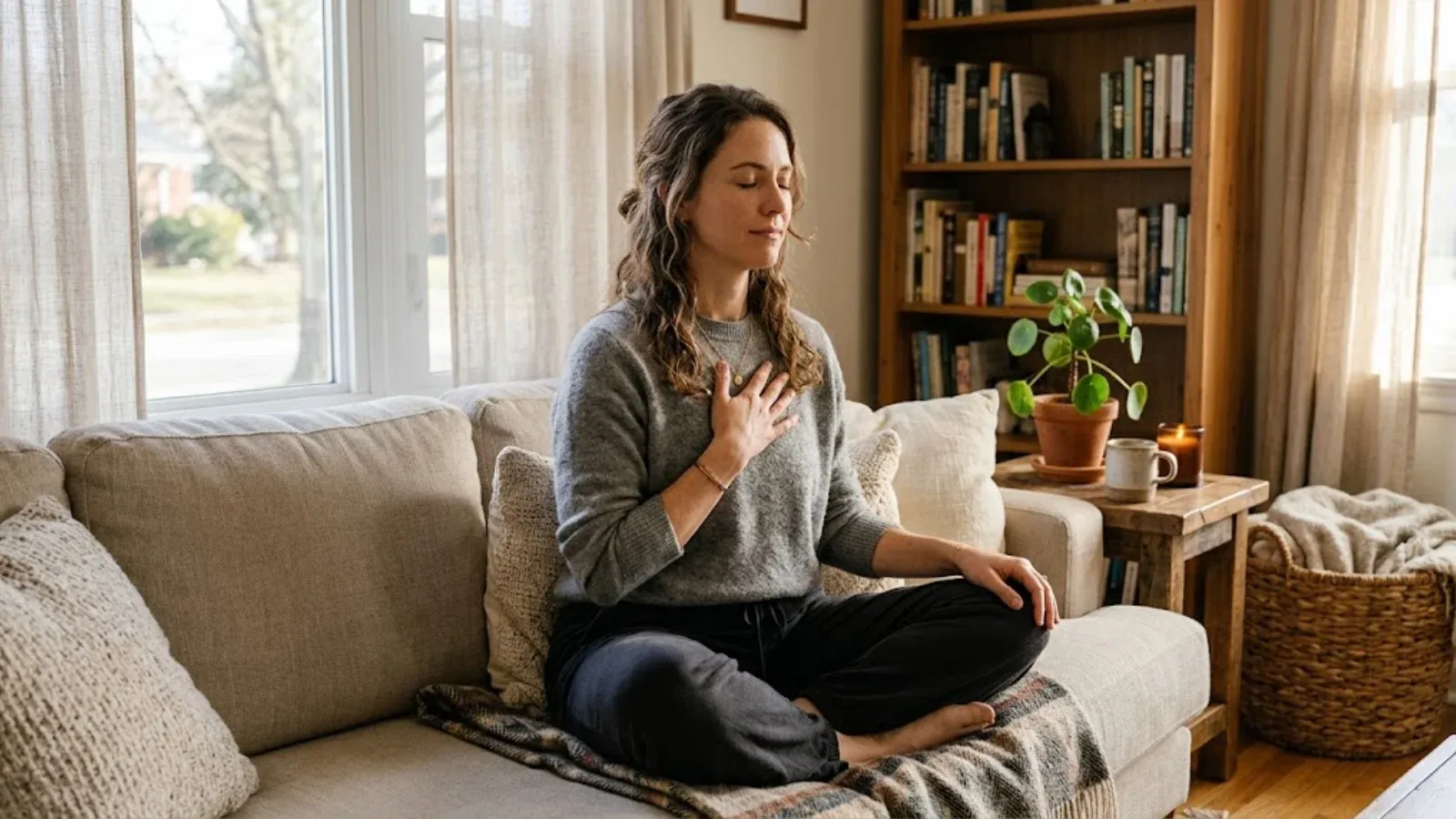
In the moment, the goal is to slow your body down so your thinking brain can come back online. These three tools take one to five minutes.
Slow, low breathing
Breathe in gently through your nose, letting your belly rise, then breathe out slowly through pursed lips, as if blowing on soup. MedlinePlus describes pursed-lip breathing and breathing from the diaphragm as techniques that help when anxiety causes over-breathing. Make the out-breath a little longer than the in-breath and repeat for one to two minutes.
Grounding through the senses
Name five things you can see, four you can touch, three you can hear, two you can smell and one you can taste. Grounding works by pulling attention away from "what if" thoughts and into the present room.
A quick muscle release
Tighten your shoulders up toward your ears for five seconds, then let them drop. Do the same with your fists and your jaw. Releasing tension tells your body the threat has passed.
A change of scene
If you can, step outside, walk to another room or get a drink of water. A small physical change interrupts the loop of checking how anxious you feel. Pair it with one slow breath and a simple statement, such as "This is anxiety. It will pass."
Which daily habits lower anxiety over time?
Daily habits lower the baseline, so spikes start from a calmer place and climb less high. They are less dramatic than in-the-moment tools, but they often matter more.
The CDC notes that physical activity can help you feel better, function better and sleep better, and that it reduces the risk of anxiety and depression. NIMH adds that stress management techniques, such as exercise, mindfulness, and meditation can also reduce anxiety symptoms.
- Move most days. A brisk 10- to 20-minute walk is enough to start.
- Keep sleep steady. A consistent wake time helps more than a perfect bedtime.
- Watch caffeine. Coffee, energy drinks and some teas can mimic or intensify anxious jitters.
- Practice a calming skill when you are not anxious. Five minutes a day builds the habit.
- Stay in touch with people. A short call or walk with a friend can interrupt a worry loop.
How do thinking skills help with worry?
Thinking skills help by changing your relationship with anxious thoughts rather than trying to force them away. These are the core of cognitive behavioral therapy (CBT), which NIMH calls the gold standard choice for psychotherapy for generalized anxiety disorder.
Name the thought
Write the worry down in one sentence. "I will mess up the presentation and everyone will think I am incompetent." Seeing it on paper often makes it smaller.
Check the evidence
Ask: What has actually happened in similar situations? What would I tell a friend who had this thought? What is a more balanced version?
Schedule worry time
Set aside 15 minutes at the same time each day to worry on purpose. When a worry appears outside that window, jot it down and tell yourself you will deal with it at worry time. Many people find the urgency fades by then.
Why does avoidance make anxiety worse?
Avoidance makes anxiety worse because it teaches your brain that the situation really was dangerous. You feel relief in the short term, but the fear grows a little stronger each time.
The gentler alternative is gradual exposure: facing a feared situation in small, manageable steps. NIMH explains that CBT helps people question unhelpful thoughts and change patterns that keep anxiety going, and approaching rather than avoiding is a big part of that.
Example: someone who avoids phone calls might start by listening to a voicemail, then leaving a short message, then making a two-minute call to a familiar business. Each step is repeated until it feels easier before moving on.
How do you build a personal anxiety coping plan?
A written plan means you do not have to think clearly at the exact moment anxiety makes thinking hardest. Follow these steps:
- List your top three triggers. For example, work emails, driving on the highway or crowded stores.
- Pick one in-the-moment tool for each trigger, such as slow breathing in the car.
- Pick one daily habit to start this week.
- Pick one thinking skill to practice, such as worry time.
- Choose one small exposure step toward something you have been avoiding.
- Rate your anxiety from 0 to 10 each evening for two weeks.
- Review and adjust. Keep what helps and swap what does not.
Can relaxation skills ever backfire?
Occasionally, yes. Some people feel more anxious at first when they focus on their breathing or body sensations, especially if physical sensations are a trigger for them. That reaction usually eases with practice, but it is worth knowing about.
The National Center for Complementary and Integrative Health (NCCIH) says relaxation techniques are generally considered safe for healthy people, but that people occasionally report increased anxiety. NCCIH advises seeing a health care provider for severe or long-lasting symptoms rather than relying only on relaxation.
If breathing exercises make you more aware of your heartbeat, try an outward-focused skill instead, such as grounding through sounds or naming objects in the room.
When should you get help for anxiety sooner?
Coping skills are not enough on their own if anxiety is constant, keeps growing or is shrinking your life. NIMH suggests seeking help when symptoms interfere with daily life, cause you to avoid things or are always present.
Get help promptly if you notice:
- Panic attacks that are frequent or come with chest pain or fainting, which should also be checked medically
- Avoiding work, school, driving or leaving home
- Using alcohol or drugs to calm down
- Thoughts of suicide or self-harm
- Anxiety that has lasted for weeks despite steady practice
What should you say when you reach out?
A clear summary helps a clinician understand your anxiety quickly. Try this checklist:
- "My anxiety shows up mostly as ___ (worry, physical symptoms, panic, avoidance)."
- "It has been this way for about ___."
- "I have tried these coping skills for anxiety: ___. This helped a little: ___."
- "I am avoiding ___ because of it."
- "I would like help with skills, an evaluation, or both."
What should Texans know about getting anxiety care?
Texans can reach anxiety care through primary care, therapists and psychiatric clinicians, and many offer video visits. Long, hot Texas summers can make outdoor exercise harder, so early-morning walks, indoor routes or shaded paths may help you keep a movement habit.
Lyte Psychiatry offers telehealth visits to patients who are physically located in Texas at the time of the visit. In-person visits are available at Lyte Psychiatry's clinic in Pantego, in the Dallas–Fort Worth area.
Getting support in Texas
If self-help has taken you as far as it can, structured support can add skills and, when appropriate, other treatment options. Lyte Psychiatry offers therapy, psychiatric evaluation and medication management in Texas. Most new patients are seen within 1–2 business days. Weekend appointments are limited. All Lyte Psychiatry services are available in Spanish. Insurance coverage and clinician fit require confirmation.
- Learn about anxiety care and therapy services.
- Try more tools in grounding techniques for anxiety.
- For stress and anxiety together, read coping skills for stress and anxiety.
- Struggling at night? See how to calm anxiety at night.
- Curious about CBT? Read CBT for anxiety and depression.
Lyte Psychiatry is an outpatient practice. It does not provide inpatient care, crisis or after-hours coverage, medically supervised detox, or intensive outpatient or partial hospitalization programs.
If you are in a mental-health crisis in the United States, call or text 988. Call 911 for immediate danger.
Educational information, not a diagnosis or individual treatment plan.
Common Questions
Frequently Asked Questions
What is the fastest way to calm anxiety?
Slow breathing with a longer out-breath is one of the quickest tools for many people. Breathe in through your nose, then out slowly through pursed lips for one to two minutes. Grounding through your senses is another fast option. Both work better if you practice them on calm days first.
Do coping skills cure anxiety?
Coping skills reduce how intense and frequent anxiety feels, but they do not usually cure an anxiety disorder on their own. Many people get the most benefit from combining skills with therapy such as CBT, and some also need medication. A clinician can help you decide what fits.
Why do breathing exercises sometimes make me more anxious?
Focusing on breathing can make some people more aware of body sensations, which can feel alarming, especially for people with panic. NCCIH notes that people occasionally report increased anxiety with relaxation techniques. Try an outward-focused skill, like naming sounds or objects around you, instead.
What is worry time?
Worry time is a set 15-minute window each day when you let yourself worry on purpose. When a worry appears at other times, you write it down and postpone it. Many people find postponed worries feel less urgent later, which helps them spend less of the day caught in anxious thinking.
Can teens use these coping skills?
Yes. Breathing, grounding, muscle release, movement and worry time can all be adapted for teens. Parents can help by practicing alongside them when everyone is calm. If a teen's anxiety leads to avoiding school, friends or activities for weeks, talk with a pediatrician or mental health professional.
How long should I practice before expecting results?
Many people notice small changes within one to two weeks of daily practice, with bigger shifts over several weeks. Track your anxiety from 0 to 10 each evening so you can see trends. If anxiety is unchanged or worse after steady practice, it is a good time to seek professional help.
When is anxiety a reason to see a professional?
See a professional if anxiety interferes with daily life, makes you avoid things, is always present or has lasted for weeks despite practicing coping skills. Seek help right away for thoughts of self-harm. In the United States, call or text 988 in a crisis, or call 911 for immediate danger.
Further Reading
NIMH — Anxiety Disorders
Diagnostic criteria and treatment options
ADAA — Anxiety Statistics
40M Americans affected — prevalence and impact data
APA — Anxiety Overview
Clinical summary from the American Psychological Association
These topic resources supplement the references linked within the article.
Your next steps for anxiety care
Choose the question that fits where you are now. Self-help tools support reflection and preparation; they do not diagnose a condition or replace care.
Who could I meet?
- Toyin Awe, PMHNP-BCPsychiatric Mental Health Nurse Practitioner
- NaTascha Jones, LPCLicensed Professional Counselor
The clinic confirms clinician fit, availability and insurance participation before scheduling.
Meet all Lyte clinicians · Understand provider roles
What will it cost, and how do I book?
Check insurance and benefits · View self-pay prices
Request an appointmentLyte Psychiatry — Texas
Anxiety Treatment — Texas
Evidence-based care for generalized anxiety, social anxiety, panic disorder, and phobias.
Find Care Near You
Lyte Psychiatry serves patients across Texas — in-person in DFW and via telehealth statewide.
Don't see your city? View all Texas locations →
Questions about cost? View insurance and payment information